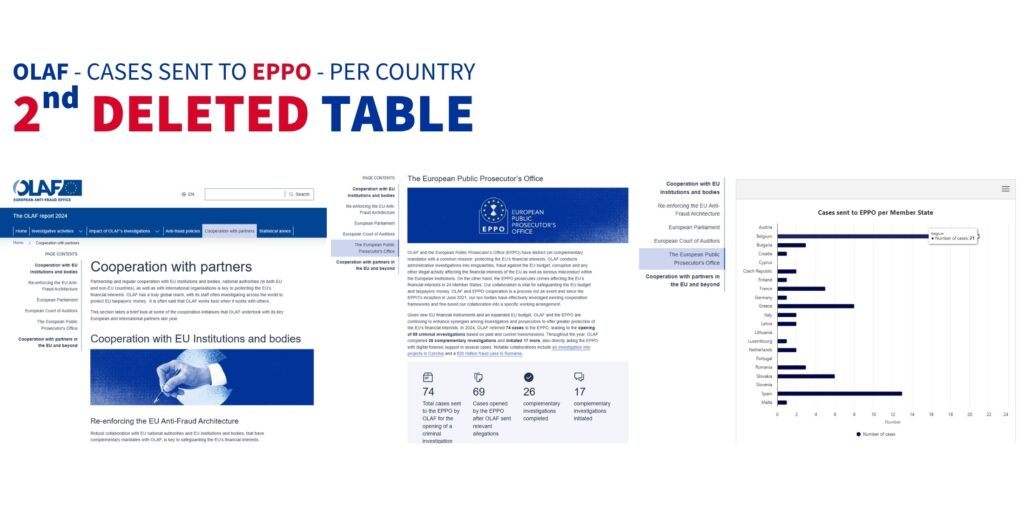
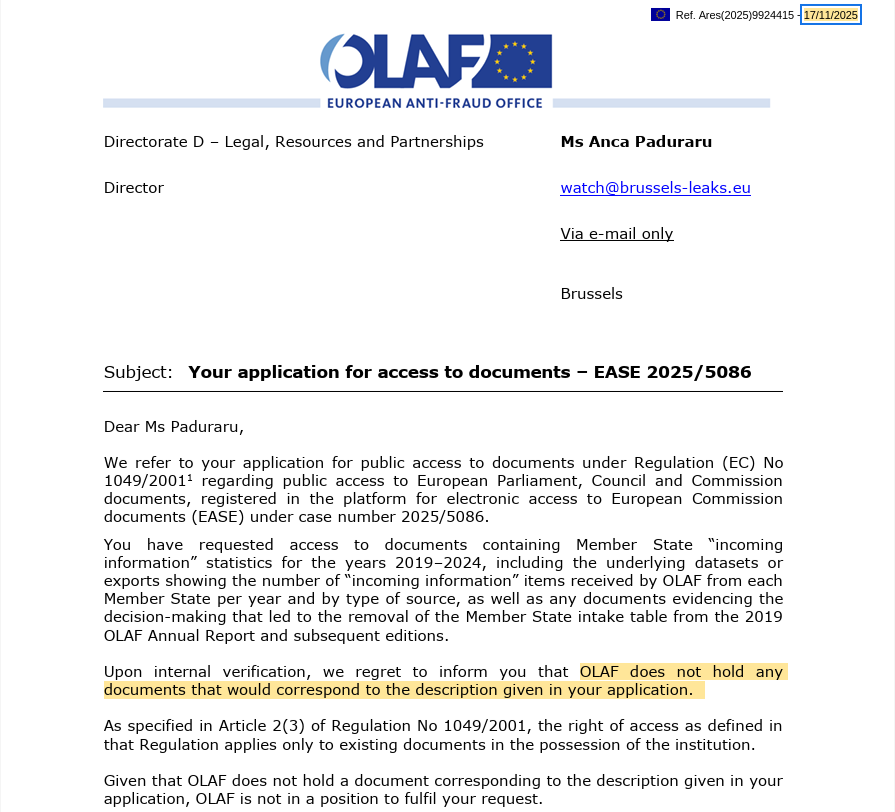
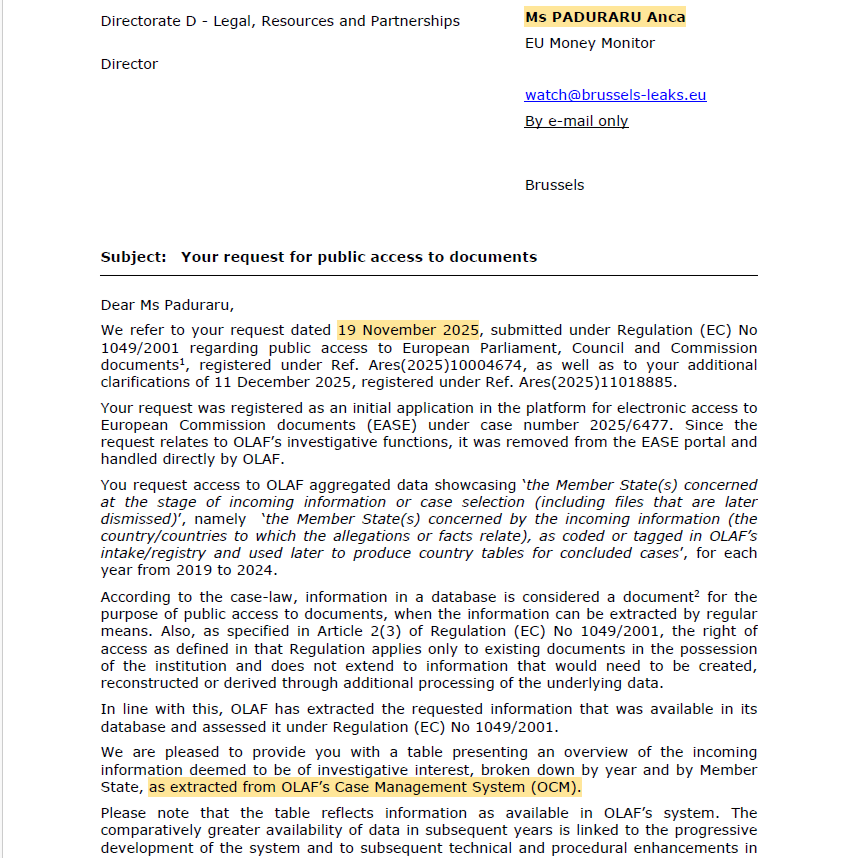
OLAF released the disappeared data, six months late, two days after simultaneous formal submissions to Parliament and OLAF’s own Supervisory Committee. Last night, within two hours of receiving it, I filed a confirmatory application for the answer still missing. The publishing record is now complete.
Here is what the table says.
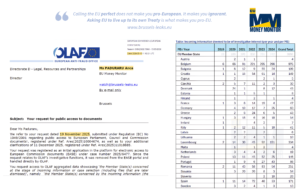
975 fraud signals of investigative interest in Belgium, 2019–2024 (source: OLAF’s own Case Management System – OCM)
4 concluded OLAF investigations in Belgium, decade 2014–2023 (OLAF Annual reports). 4 more concluded in 2024, the year this investigation went public
36.1% of all EU member state fraud signals: Belgium alone – 975 of 2,698 total EU cases
334 fraud signals in Luxembourg, 2019–2024, 0 concluded OLAF investigations in Luxembourg, 2014–2024 – not one. Ever.
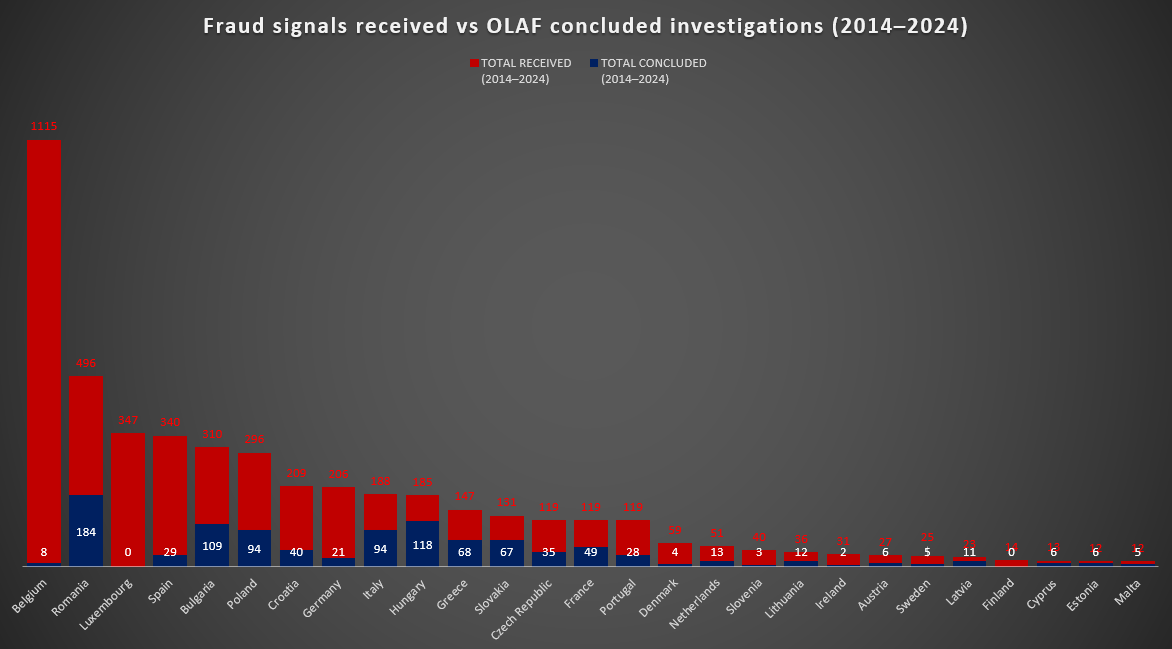
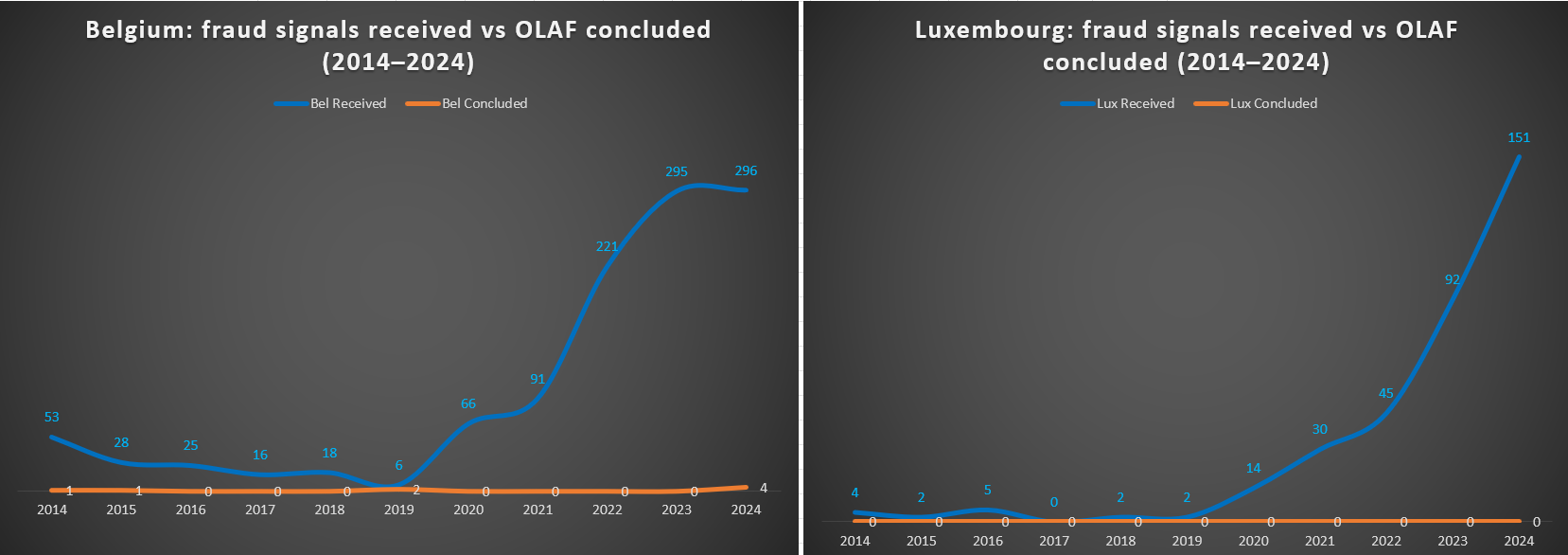
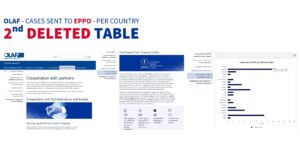
The pattern is visible, when the number of incoming fraud signals started to increase and yet the concluded cases remained low, OLAF stopped publishing the incoming table.
The table provided by OLAF covers incoming information deemed to be of investigative interest, extracted from OLAF’s Case Management System (OCM), broken down by Member State and year, 2019 to 2024. These are cases OLAF’s own system classified as warranting investigative attention. What arrived before that filter, allegations not deemed of investigative interest, is not recorded and was not provided. The 975 for Belgium is therefore a floor, not a ceiling.
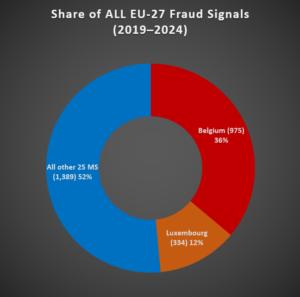 What Belgium’s number means
Belgium is not the quiet country that “4 OLAF investigations” suggest. It is the most active case in OLAF’s own intake database. With 975 cases of investigative interest between 2019 and 2024, Belgium accounts for more than a third of every fraud signal logged across all 27 EU member states. It generated more intake than France, Germany, Italy, Spain, Poland, and Romania and Bulgaria. Combined.
Why this day matters
In March 2025, EU Money Monitor published the OLAF Fraud Index: concluded investigations per EUR 1 billion of EU direct management funding, for every EU member state, derived from OLAF’s own published annual reports for 2014 to 2023. Belgium: 0.13 concluded investigations per EUR 1 billion. Romania: 9.84. A 77-to-1 ratio. Bulgaria: 12.75, the highest in the dataset. Belgium: second-lowest in the EU, ahead only of Finland and Luxembourg, both at 0.00.
Belgium receives EUR 31.16 billion in EU direct management funding over that period. It is the EU’s second-largest recipient of direct grants to NGOs. It hosts the European Commission, the Parliament, the Council, and OLAF itself.
The Fraud Index was built on OLAF’s published output data: concluded investigations. What it could not show was the input side, how many fraud signals OLAF had actually received per country.
Without that denominator, three explanations for Belgium’s 0.13 rate were all technically consistent with the evidence: genuinely low fraud incidence; structurally low detection and reporting capacity; or investigative prioritisation that is not proportionate across member states. The public record did not allow any reader to distinguish between them.
The part OLAF still will not answer
My original FOI request had two parts.
- Part A, the intake data, OLAF provided yesterday.
- Part B, all documentation of the institutional decision to remove the country-level intake table from OLAF’s annual reports from 2019 onwards: the internal notes, memos, emails, legal assessments, Director-General approvals. This part was not addressed, not refused, not acknowledged. It was erased from OLAF’s own account of the question it was answering.
OLAF published this transparency table for approximately fifteen years. Six consecutive annual reports were transmitted to European Parliament, the Council of the European Union, the European Commission, and the European Court of Auditorswithout it.
There must be a decision behind that. A record. An instruction. An approval. OLAF has not produced it and has not explained its absence.
The confirmatory application I filed last night formally demands either that document trail or the specific legal exception under which it is being withheld. Those are the only two options the law provides.
Belgium still does not have implemented the NAFS – National Anti-Fraud Strategy. The EU system appears to structurally reward the absence of anti-fraud infrastructure with the appearance of anti-fraud integrity. The OLAF intake table confirms that argument was correct: the signals were there. 975 of them.
Parliament closed the accountability cycle without this
On 29 April 2026, the European Parliament voted to discharge the EU Commission’s 2024 accounts, formally closing accountability oversight on how public money was spent.
It voted without knowing that Belgium had 975 fraud signals at OLAF and 6 concluded cases. Without knowing the intake table had been missing for six years. Without knowing the decision trail for removing it has never been explained.
The vote passed. The accountability cycle closed.
On 11 May 2026, I placed this full file before the European Parliament’s Committee on Budgetary Control and before the OLAF Supervisory Committee.
The OLAF reply arrived 48 hours later.
What this means for EU citizens
Every euro in EU grants – to NGOs, to research programmes, to infrastructure, to democratic support initiatives – was collected from European citizens and businesses with the legal assurance that it would be protected by an anti-fraud architecture proportionate to the risk.
The institution created in 1999 to provide that protection, as a direct consequence of the only Commission resignation in EU history, received 975 fraud signals about the member state hosting every EU institution. It concluded 4 investigations in a decade. It has not explained why.
Transparency does not weaken institutions. Transparency is the condition of their legitimacy. An OLAF that can demonstrate its investigative function is proportionate to fraud signal, across all member states, with a published and verifiable denominator, is a stronger institution than one whose annual report lacks that denominator for six consecutive years. That is the argument this investigation has made from the beginning.
The full institutional record, every submission, every FOIA reply, every non-reply, the confirmatory application filed last night, is published verbatim at https://money-monitor.eu/the-record/.
Staying quiet when you see wrongdoing is not diplomacy. It is complicity. So I used my journalism degree, built EU Money Monitor, and discovered that one press credential opens doors I could not open as “just”a citizen. That fact alone says everything about the state of EU transparency.
Calling the EU perfect does not make you pro-European. It makes you ignorant. Asking it to live up to its own Treaty is what makes you pro-EU.
Citizens fund this system, they should be able to verify it. That is why I built the Belgium NGO Funding Intelligence Pack, as a pilot: 758 NGOs and non-profits, EUR 7.89 billion, four public registries, zero EU funding.