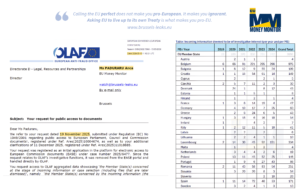
915 concluded OLAF investigations across the EU-27 between 2014 and 2023. 324 more outside the EU. Belgium appears in four of them in the decade 2014-2023.
Not four percent, not four per year. Four total, across a decade, two concluded investigations during each mandate, Giovanni Kessler and Ville Itälä.
Romania recorded 164. Hungary 110. Bulgaria 97. Italy 87. Belgium recorded 4. On the same public record, Belgium also sits below Congo, with 7, and Uganda, with 6.
That matters because Belgium is not marginal to the EU funding system, it is one of its main centres. Between 2014 and 2023, Belgium received roughly €31.16 billion in EU funding under direct management, placing it sixth in the Union by total volume. It sits behind Spain, Italy, France, Germany and Poland. It is not a small player at the edge of the budget, it is one of the places where EU money lands at scale.
The OLAF Fraud Index
This article includes the OLAF Fraud Index, which plots concluded OLAF investigations per €1 billion of EU funding received under direct management between 2014 and 2023. The formula is simple: number of concluded investigations × 1000 ÷ funding in million euro.
It is not a fraud map, it is a scrutiny map. It shows where OLAF’s activity concentrates, and where it is almost absent, compared with the money each country receives.
On that measure, Belgium, which hosts the European Commission, the European Parliament, the Council, and OLAF itself, records about 0.13 concluded investigations per €1 billion received. Romania records about 9.8. Hungary about 12.1. Bulgaria about 12.75, the highest value in the dataset. Italy stands at just under 1.
Raw totals tell part of the story. Adjusting for funding volume makes it impossible to ignore.
The OLAF Fraud Index
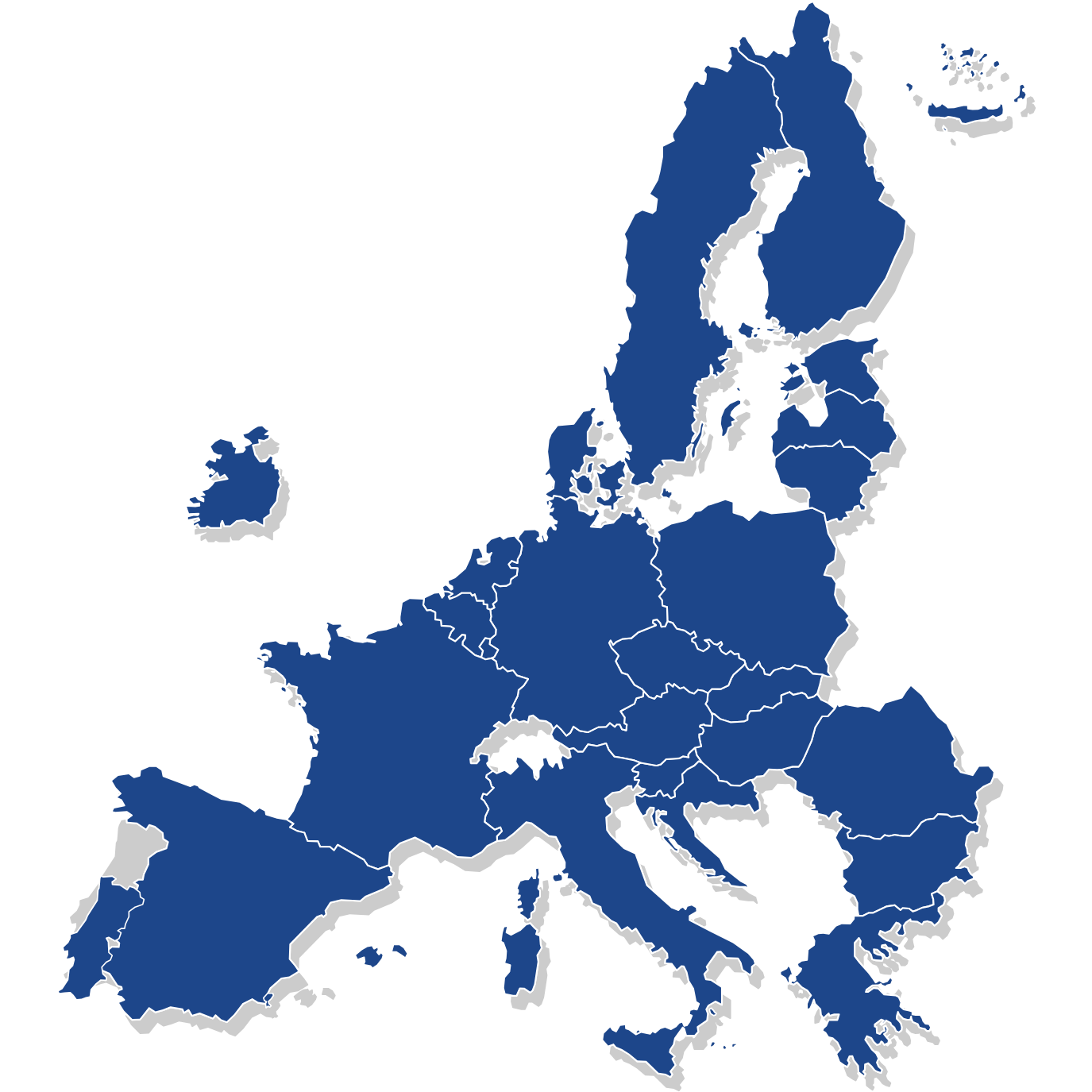
OLAF Fraud Index: concluded OLAF investigations per €1 billion of EU funding received under direct management, 2014–2023. The map does not measure actual fraud prevalence. It shows where OLAF’s visible administrative activity is concentrated, and where it remains unusually thin, relative to the money involved.
BULGARIA
Total EU funding: €7,61 bn
OLAF concluded investigations: 97
Cases/€bn: 12.75
*FI Score: 100
HUNGARY
Total EU funding: €9,11 bn
OLAF concluded investigations: 110
Cases/€bn: 12.07
*FI Score: 94.7
ROMANIA
Total EU funding: €16,65 bn
OLAF concluded investigations: 164
Cases/€bn: 9.85
*FI Score: 77.2
SLOVAKIA
Total EU funding: €8,05 bn
OLAF concluded investigations: 61
Cases/€bn: 7.58
*FI Score: 59.4
MALTA
Total EU funding: €0,63 bn
OLAF concluded investigations: 4
Cases/€bn: 6.37
*FI Score: 50.0
CROATIA
Total EU funding: €7,46 bn
OLAF concluded investigations: 32
Cases/€bn: 4.29
*FI Score: 33.6
LATVIA
Total EU funding: €3,37 bn
OLAF concluded investigations: 10
Cases/€bn: 2.97
*FI Score: 23.3
CZECH REPIBLIC
Total EU funding: €11,92 bn
OLAF concluded investigations: 31
Cases/€bn: 2.60
*FI Score: 20.4
GREECE
Total EU funding: €24,62 bn
OLAF concluded investigations: 63
Cases/€bn: 2.56
*FI Score: 20.1
POLAND
Total EU funding: €35,21 bn
OLAF concluded investigations: 86
Cases/€bn: 2.44
*FI Score: 19.2
ESTONIA
Total EU funding: €2.48 bn
OLAF concluded investigations: 6
Cases/€bn: 2.42
*FI Score: 19.0
LITHUANIA
Total EU funding: €4.63 bn
OLAF concluded investigations: 11
Cases/€bn: 2.37
*FI Score: 18.6
PORTUGAL
Total EU funding: €20,06 bn
OLAF concluded investigations: 28
Cases/€bn: 1.40
*FI Score: 11.0
CYPRUS
Total EU funding: €2,51 bn
OLAF concluded investigations: 3
Cases/€bn: 1.19
*FI Score: 9.4
ITALY
Total EU funding: €88,05 bn
OLAF concluded investigations: 87
Cases/€bn: 0.99
*FI Score: 7.8
SLOVENIA
Total EU funding: €3.37 bn
OLAF concluded investigations: 3
Cases/€bn: 0.89
*FI Score: 7.0
FRANCE
Total EU funding: €62,69 bn
OLAF concluded investigations: 45
Cases/€bn: 0.72
*FI Score: 5.6
AUSTRIA
Total EU funding: €9.25 bn
OLAF concluded investigations: 6
Cases/€bn: 0.65
*FI Score: 5.1
NETHERLANDS
Total EU funding: €18.1 bn
OLAF concluded investigations: 11
Cases/€bn: 0.61
*FI Score: 4.8
SWEDEN
Total EU funding: €9.57 bn
OLAF concluded investigations: 5
Cases/€bn: 0.52
*FI Score: 4.1
IRELAND
Total EU funding: €5.12 bn
OLAF concluded investigations: 2
Cases/€bn: 0.39
*FI Score: 3.1
DENMARK
Total EU funding: €8.2 bn
OLAF concluded investigations: 3
Cases/€bn: 0.37
*FI Score: 2.9
GERMANY
Total EU funding: €53,65 bn
OLAF concluded investigations: 19
Cases/€bn: 0.35
*FI Score: 2.8
SPAIN
Total EU funding: €95,8 bn
OLAF concluded investigations: 24
Cases/€bn: 0.25
*FI Score: 2.0
BELGIUM
Total EU funding: €31.16 bn
OLAF concluded investigations: 4
Cases/€bn: 0.13
*FI Score: 1.0
FINLAND
Total EU funding: €6.3 bn
OLAF concluded investigations: 0
Cases/€bn: 0.0
*FI Score: 0.0
LUXEMBOURG
Total EU funding: €6.1 bn
OLAF concluded investigations: 0
Cases/€bn: 0.0
*FI Score: 0.0
Why the numbers look the way they do
Under Article 5 of Regulation (EU, Euratom) No 883/2013, OLAF opens investigations when there is sufficient suspicion of fraud, corruption, or another illegal activity affecting EU financial interests. That suspicion must come from somewhere.
The countries with the most concluded OLAF investigations share one structural characteristic: each operates a dedicated national anti-fraud body that systematically generates referrals. Romania’s DLAF and DNA, Hungary’s Központi Nyomozó Főügyészség, Bulgaria’s AFCOS, Italy’s Guardia di Finanza — each produces a consistent pipeline of signals that OLAF can act on.
Belgium has no dedicated national anti-fraud office for EU funds. Luxembourg has none either.
The result is a feedback loop. No dedicated referral body means fewer signals reach OLAF. Fewer signals mean fewer investigations. Fewer investigations produce a clean statistical record. A clean statistical record reduces external pressure for scrutiny. The system rewards the absence of anti-fraud infrastructure with the appearance of anti-fraud integrity.
OLAF did not address one single question we asked. They do not publish the number of allegations received per country, nor did they refer to the number of fraud suspicions reported in Belgium.
The questions we asked OLAF
- Does OLAF actively prioritize certain countries while ignoring others?
- Why doesn’t OLAF publish the number of allegations received per country?
- How many fraud suspicions were reported in Belgium and Luxembourg but not pursued?
- Does OLAF rely disproportionately on incoming allegations from national anti-fraud offices? If so, how does this impact countries without such offices?
- How does OLAF ensure balanced scrutiny across all member states? Are there mechanisms to proactively investigate underreported countries?
- Does OLAF believe that fewer investigations correlate with lower fraud levels, or could this indicate systemic underreporting?
- Would OLAF recommend mandatory anti-fraud offices for all member states to ensure consistent reporting and oversight?
What OLAF did answer:
“Please note that OLAF’s investigative decisions are not based on geographical distribution or volume targets per country. OLAF does not and cannot initiate investigations merely to “balance” numbers across Member States. OLAF’s Director-General may open an investigation based on Article 5 Regulation 883/2013, if there is sufficient suspicion of fraud, corruption or other illegal activity affecting the financial interests of the Union. The volume of OLAF investigations per country cannot be interpreted as a proxy for the level of fraud with EU funds in that country.
OLAF Press Office”