That missing table was not decoration, it was the public instrument panel.
For years, OLAF’s annual report showed two things that mattered: what came in, and what went out. The minimum public baseline for judging whether Europe’s anti-fraud office was doing its job, the one ratio that matters in any oversight system. Intake versus outcomes. Activity versus action.
Under Giovanni Kessler, that baseline existed. The country-by-country intake table was imperfect, OLAF said so itself, the 2015 annual report warned it was “not always easy to determine where the informant is resident” and that figures should be “interpreted with caution”. OLAF knew the limitations. It published the table anyway, because imperfect data in public serves democratic oversight better than no data at all. Citizens, journalists, and MEPs could compare what arrived at OLAF’s door against what it chose to pursue.
Then, in 2019, Ville Itälä’s first full reporting year, the table was gone. No note in the annual report, no press release, no stated legal basis, no replacement metric that preserves even a rough intake-versus-outcome ratio.
What replaced it: aggregate by-source figures, curated success stories, and headline case counts stripped of the denominator that gives them meaning. The public can no longer see what OLAF receives, only what it concludes.
Outputs without inputs is marketing, performance without a baseline.
Belgium sits at the centre of this problem. In a decade OLAF concluded four fraud investigations. Fewer than Congo, fewer than Uganda. The 2018 intake table shows Belgium generated 18 complaints that year alone. What happened to those complaints, and to every complaint about Belgium in the five years since the table was removed, is unknown.
Was it a managerial decision, a political accommodation, institutional fatigue with criticism, or something else entirely? Why was it not replaced with meaningful data? Only OLAF’s directors, past and present, know.
Without intake data, low concluded cases become unreadable. They could reflect low fraud. They could equally reflect low follow-up, weak referral chains, or selective prioritisation of the signals that arrive. The public cannot know, the data that would allow that judgment was removed, and nobody in any EU institution has publicly demanded it back, until now.
What OLAF said when formally asked
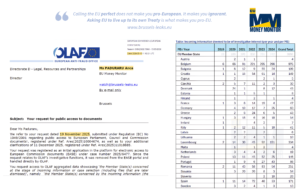
On 5 October 2025, a formal access-to-documents request, EASE 2025/5086, asked OLAF for two things: the Member-State intake data for 2019–2024 and the internal record explaining why the country-by-country intake table disappeared after 2018. OLAF extended the deadline once, then replied on 17 November 2025. It did not invoke confidentiality, operational sensitivity or any Article 4 exception under Regulation 1049/2001. It said it held no documents matching the request and added the sentence that matters most: for 2019–2024, “no official data matching your description are available, nor are they recorded internally by OLAF”.
The problem was not only the answer, it was the way OLAF got there.
OLAF answered as if the request concerned the nationality or residence of whistleblowers. That is the logic of its letter: anonymous sources, cross-border sources, the impossibility of knowing with certainty from which Member State a person reported, and therefore the impossibility of producing a Member-State breakdown.
But that was not the request. The request was about the Member State concerned by the allegation: the country the incoming information was about.
The technicality behind opaqueness
OLAF’s 2025 reply did not uncover a new methodological problem, did not accept the shortcomings or try to correct them; OLAF just reframed the request.
OLAF’s own historical reports show it clearly. In the 2014 report, Figure 9 is explicitly titled “Incoming information from Member States” and already notes that many private sources could not be attributed to a country. Logical. In the 2015 report, OLAF again explicitly warned that it was “not always easy to determine where the informant is resident” and that the figures should be interpreted with caution. Logical again.
OLAF knew the table had limits. It published it anyway for years, with caveats. What it removed after 2018 was the only public country-level intake baseline it had.
The residence of an informant is indeed irrelevant. But for the mandatory transparency you must be subjected to, why not just publish the table “Member State concerned by the allegation” – the country the incoming information was about?
The Commission’s own Secretariat-General then stepped in
A confirmatory application filed on 19 November 2025 argued that OLAF had misinterpreted the scope of the request. It asked the Commission to reassess the file and run a renewed search. On 11 December 2025, the Secretariat-General accepted that point. Its decision explicitly refers to the possibility that the original request had been misinterpreted, says that a renewed search would be conducted, and registers a new initial case: EASE 2025/6477.
Then came the delays for “internal consultations”. On 3 March 2026, a formal reminder noted that no substantive answer had yet been received. The email was read the same day.
Six months later, with the update of this article, 3 April 2026, OLAF has not answered, not to the missing intake data, not to the internal record of who decided to remove it and why.
The EPPO standard
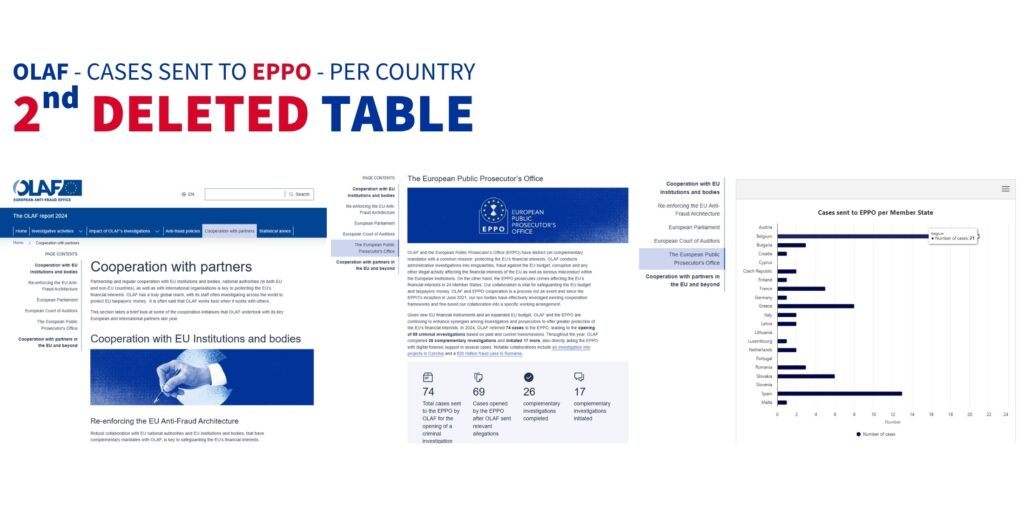
EPPO, the European Public prosecutor’s Office, OLAF’s criminal counterpart, operational since 2021, publishes both reports received and investigations opened by country, every year. Italy in 2024: 698 reports received, 458 investigations opened. The ratio is public. The attrition is visible. Citizens can evaluate it.
OLAF, which has existed for twenty-five years and manages the broader administrative anti-fraud mandate across the entire EU budget, publishes less accountability information today than it did when the euro was new. An institution built four years ago is already more transparent about its front door than the one it was designed to complement.
From transparency to curation to omission
OLAF’s mission is to protect EU funds, not the EU’s image. The minimum standard for any credible anti-fraud institution is a publicly visible chain: alerts received, cases opened, investigations concluded, outcomes delivered. OLAF currently shows just the last two steps. The first two, as imperfect as they were, disappeared in 2019, the data was apparently not retained, the decision record has not been disclosed.
In twenty years, OLAF’s public reporting has moved from transparency to curation to omission, precisely as EU budgets grew and the stakes of accountability increased.
The table existed for fifteen years. Explaining why it was removed, not replaced, should take fifteen minutes, not six months.
That is not transparency.
That is a transparency hit.