I want to translate what the Court found into plain language, because in audit terms it sounds technical, and what it actually means is more serious than the technical version sounds.
The European Commission does not systematically collect actual-cost data by measure for the RRF, even where Member States hold it. It also does not require full public traceability below public bodies, to the contractors and sub-contractors who actually carry out the work. The Commission’s stated position is that the RRF Regulation does not provide a legal basis to ask. The Court’s response, repeated in unmistakable terms across the audit, is that the absence of this data impairs the Commission’s ability to assess efficiency, and therefore sound financial management.
“Impairs.” That word matters, so does the second word the Court added to the public record on it tonight.
The institutional verification gap
There is a public verification gap, the Court has documented it, citizens cannot reconstruct the funding chain on €577 billion from public records.
There is also an institutional verification gap, and that is the more serious finding.
The Commission’s stated position, recorded in the Court’s report, is that the RRF Regulation does not provide a legal basis to require Member States to submit actual cost data by measure. The Court’s finding is that this absence impairs its ability to assess efficiency, and therefore sound financial management.
Sound financial management is Article 317 of the Treaty on the Functioning of the European Union, the first operational principle of the EU budget. Article 33 of the Financial Regulation breaks it down into three measurable criteria: economy, efficiency, and effectiveness. The Treaty requires the Commission to implement the budget under sound financial management. On the RRF, the Court has now said the missing actual-cost data limits the Commission’s ability to assess efficiency, and Maletić’s written reply adds that important limitations remain on both efficiency and effectiveness.
What ECA Member Ivana Maletić told me, in writing, after the briefing
After this morning’s briefing I asked the Court for an on-the-record written reply on the cumulative pattern across recent ECA reports and the implications for the next EU budget. The reply, attributable to ECA Member Maletić, came back just before publication. The decisive paragraph:
“The RRF was presented as a performance-based instrument intended to deliver concrete results. In practice, however, many milestones and targets relate primarily to inputs or procedural steps rather than measurable outputs or results. For example, funding may be reported as disbursed to SMEs without sufficient information on the concrete transformation, investment or results achieved through that support. […] The Court therefore considers that important limitations remain regarding both efficiency and effectiveness under the current model. These lessons are particularly relevant in the context of discussions on future EU instruments based on the RRF model.”
The Court’s written reply places both efficiency and effectiveness on the record, two of the three pillars of sound financial management. And the Court has explicitly tied today’s RRF audit to the next EU budget being negotiated this year.
The Court also recognises the exceptional crisis context in which the RRF was created, and the need to balance transparency with proportionality. That caveat matters, and it deserves to travel with the finding. But it does not erase the central conclusion: the lessons from the RRF model should not be repeated in the next budget.
This is not an isolated audit
Today’s report is the latest in a growing chain of ECA reports, reviews and opinions warning that EU funding models are being expanded before traceability, transparency and accountability have been fixed. Special Report 11/2025 found that obtaining a reliable overview of EU funding granted to NGOs was, in practice, not possible. The Court’s annual report on the 2024 financial year issued an adverse opinion on the legality of EU budget expenditure for the sixth consecutive year, and a qualified opinion on RRF spending for the third. ECA opinions in January and February 2026 raised the same architectural concerns about the next Competitiveness Fund, the next Horizon Europe, and the National and Regional Partnership Plans — the €865 billion centrepiece of the next budget.
What citizens are allowed to see, and what is hidden
Each Member State has to publish its 100 largest final recipients of RRF money. That requirement was added two years after the fund launched. The Court’s analysis across ten Member States: more than half of those published recipients are public bodies, and over 80% of the published amounts go to those public bodies. Member States are not required to publish what those public bodies subsequently pay to contractors below them through public procurement. So they don’t.
Citizens see the first public door. They do not see the room behind it, where the money is actually spent.
In France, five entities on the published top 100 are intermediary bodies, not final recipients, €3.6 billion of the €8.3 billion total is mislabelled, and France could not provide the auditors with the names of final recipients for three of the five measures sampled. In Spain and Romania, the published amounts are amounts awarded, not amounts received. The RRF Regulation requires amounts received.
The Court identifies Bulgaria as the only sampled Member State showing a full public drill-down model, final recipients, contractors, sub-contractors and paid amounts, for every EU programme. It does not identify any of the other nine sampled countries as matching that level of public traceability. Bulgaria shows that fuller public traceability is technically possible under existing national systems.
My Belgium investigation tests the same five links
EU Money Monitor’s Belgium pilot tests the same architecture on a different stream of EU funds. Across €7.89 billion paid to 758 verified Belgian NGOs and not-for-profit entities between 2014 and 2024 (covering 92.41% of Belgian NGO-NFPO EU-funding), reconciled against four official Belgian public registries, the public funding chain cannot be reconstructed end to end from public records.
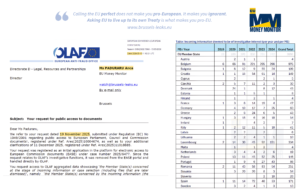
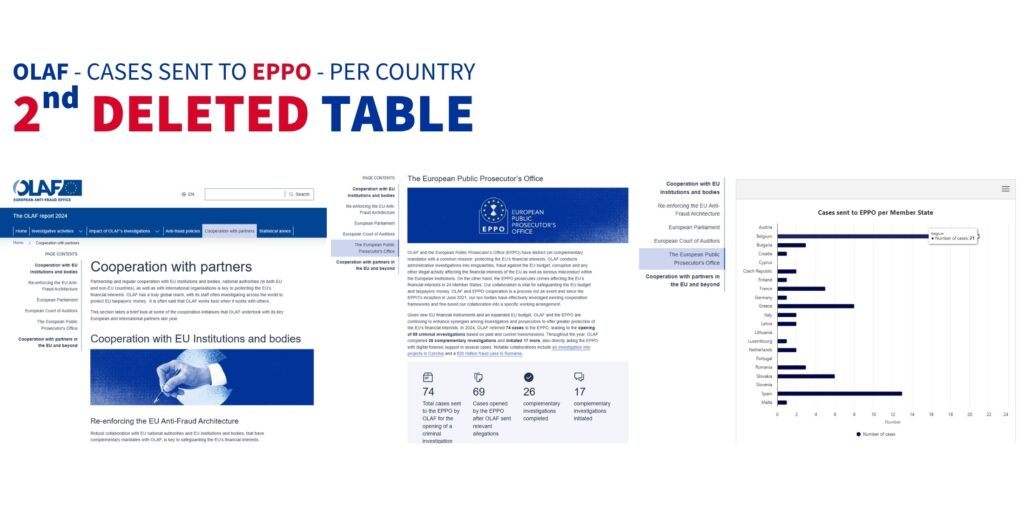
Different fund, same question. Can a citizen follow EU money through the five links of public accountability — publication, legal entity, workforce, anti-fraud detection, and discharge? In Belgium, the answer at every link is no. Publication exists. Legal-entity verification stalls where Belgian filing rules permit incomplete public accounts. Workforce verification stalls where ONSS bands and Code 61 contractor accounting do not name hours, rates or workers. Anti-fraud detection visibility is uneven — Belgium 0.13 OLAF cases per €1 billion against Romania 9.84, on OLAF’s own published numbers, with country-level intake data absent from OLAF’s annual reports since 2019. And the discharge link, today, is what the Parliament voted on eight days ago.
Two official records support that reading. In its replies to ECA Special Report 11/2025, the Commission acknowledged that its risk-scoring tool Arachne “cannot be used to sufficiently identify NGOs” and that risk identification “relies mainly on self-declarations.” On 24 April 2026, the European Court of Auditors replied to EU Money Monitor that my analysis confirms some of its observations on weaknesses in the Commission’s transparency regarding EU funding granted to NGOs.
The European Parliament has been saying this too
On 29 April 2026, the European Parliament voted on the Commission’s 2024 budget. Discharge was granted, but the resolution places on the official record that the Commission’s interpretation of “final recipient” under the RRF contradicts existing legislation. The rapporteur, Daniel Freund , set the deadline: publish a complete list of final recipients by 31 December 2026, or Parliament will consider legal action.
In her written reply to me today, Maletić confirmed the alignment in plain words:
“Parliament has repeatedly highlighted concerns regarding transparency, traceability and the lack of sufficient information on concrete results and final recipients. Parliament has also stressed that these shortcomings should not be repeated in future instruments.”
Why discharge matters
This is why discharge matters. Parliament’s role is not ceremonial. Under Articles 317 and 319 TFEU, the Commission implements the budget and Parliament grants discharge, and under Article 234, Parliament also holds the ultimate political sanction over the Commission as a body. That threshold is high, and rightly so.
The institutional architecture for responding to audit findings on sound financial management is established in the Treaties. The European Court of Auditors has now issued six consecutive adverse opinions on the legality of EU budget expenditure — documented in each ECA Annual Report from 2019 to 2024. Under Articles 317 and 319 TFEU, the Commission implements the budget and Parliament grants discharge. Repeated audit findings on efficiency, effectiveness and traceability belong at the centre of that discharge process. That is what the Treaties require, and what the documented record now tests.
The Treaty article is intact, the precedent exists, the European Court of Auditors has now issued six consecutive adverse opinions on the legality of EU budget expenditure — the longest such run on the Commission’s audit file. The point is the simple one: repeated audit findings on sound financial management belong at the centre of democratic control.
The next budget is being written right now
The Commission has proposed a 2028–2034 long-term EU budget worth almost €2 trillion. €865 billion sits inside the National and Regional Partnership Plans, modelled on the RRF.
The Court’s audit lead said it in the press release, and confirmed it in writing under her name this afternoon.
“These RRF transparency gaps should not spill over into the EU’s future budgets. […] These lessons are particularly relevant in the context of discussions on future EU instruments based on the RRF model.”
The institutions that have to act now are the European Parliament , in the next discharge cycle, and the Council and Parliament, in the negotiations on the post-2027 budget architecture and its sectoral rules.
The decision in front of them is whether the next €2 trillion EU budget is built on the architecture the Court has been auditing, or on the architecture Bulgaria has shown is possible. That is the question this story is actually about. The deadline for an answer is 31 December 2026.
Special report 14/2026: RRF traceability and transparency
Audit led by ECA Member Ivana Maletić, Audit Chamber IV.
Question:
The Court has now issued six consecutive adverse opinions on the legality of EU budget expenditure and three consecutive qualified opinions on the RRF. Special Report 14/2026 finds that the Commission does not request actual cost data by measure for the RRF, and that this gap impairs its ability to assess efficiency and sound financial management. Special Report 11/2025 reached a parallel finding on EU funding granted to NGOs. Review 02/2025 consolidated the lessons from the RRF model. Special Report 22/2024 found that EU control systems lack essential elements to mitigate the increased risk from the FNLC model. Special Report 26/2025 found that EU anti-fraud co-operation does not meet its own statutory deadlines and duties.
Across that chain, does the Court consider that the principle of sound financial management under Article 317 TFEU can still be demonstrated where the institution managing the funds neither collects nor systematically uses the data its own auditors say is needed to verify economy, efficiency and effectiveness? And what is the threshold below which the Court would say the principle is not met?
Full answer:
The Treaty and the Financial Regulation establish clear requirements regarding sound financial management, transparency and traceability. This is why the Court examines whether the information available is sufficient to assess efficiency and effectiveness. These principles also apply to financing not linked to costs (FNLC), including the RRF model.
In this audit, the Court focused particularly on efficiency, because the absence of reliable information on actual costs limits the Commission’s ability to assess whether resources were used efficiently. However, this concern is not new. In earlier audits and reviews, the Court also identified weaknesses regarding efficiency and effectiveness.
The RRF was presented as a performance-based instrument intended to deliver concrete results. In practice, however, many milestones and targets relate primarily to inputs or procedural steps rather than measurable outputs or results. For example, funding may be reported as disbursed to SMEs without sufficient information on the concrete transformation, investment or results achieved through that support. This makes it difficult to assess the results of the instrument.
The Court therefore considers that important limitations remain regarding both efficiency and effectiveness under the current model. These lessons are particularly relevant in the context of discussions on future EU instruments based on the RRF model.
At the same time, the Court recognises the exceptional circumstances under which the RRF was created. The instrument was designed rapidly in response to a major economic crisis, with the objective of preventing a severe downturn similar to the crises of 2008 and 2010. The speed and urgency of implementation inevitably affected the design of milestones, targets and reporting arrangements.
This context has also been recognised by the European Parliament in the discharge procedure. While discharge has been granted, Parliament has repeatedly highlighted concerns regarding transparency, traceability and the lack of sufficient information on concrete results and final recipients. Parliament has also stressed that these shortcomings should not be repeated in future instruments.
The ongoing discussions on proposed new performance-based funding models therefore remain highly important. During debates in the European Parliament, concerns were again raised regarding the repetition of weaknesses previously identified by the Court. The Court’s recent reports and opinions aim to support the legislator in addressing these issues, including through clearer standards in the Financial Regulation itself on transparency, traceability and reporting requirements.
Regarding thresholds, the Court recognises the need to balance transparency with proportionality and administrative burden. Member States have argued that reporting every individual expenditure by final beneficiaries would create excessive administrative burden. The Court’s position is that transparency should focus primarily on the level of public expenditure – for example, the amount of public funding granted to an SME or non-profit organisation – rather than every invoice or internal transaction of the beneficiary.
The Court has not proposed a specific threshold at this stage. This remains a matter for discussion in the legislative process for future EU financial instruments. However, one possible benchmark for discussion could be the threshold of very low-value contracts below EUR 15 000, as referred to in the Financial Regulation and in the Commission guidance on Recovery and Resilience Plans in the context of REPowerEU.