The five letters, with full attachments, are downloadable below. What follows is a short account of what each one contains and why it had to be sent.
Not one figure in any of these letters comes from an external source. Every legal contradiction documented was derived from the institutions’ own Treaty obligations, their own Financial Regulation, their own FOIA replies to me, their own annual reports, and their own formal written responses to the European Court of Auditors.
Why these letters exist
In April 2025, the European Court of Auditors published Special Report 11/2025. Paragraph 40 of that report contains the phrase that has defined European NGO oversight for a year: obtaining a reliable overview of EU funds received by NGOs is “practically impossible”. The Court documented that over 70,000 payment entries in the Commission’s own internal accounting system for 2021 to 2023 were never categorised as NGO or non-NGO, because the classification field was left blank. The Commission accepted Recommendation 2 on beneficiary identification with a target implementation date of 2029. Eleven years after the same classification failure was first flagged in ECA Special Report 35/2018.
I built what the institutions said was practically impossible to build, four public registries, one citizen with a laptop, no institutional access, no public funding. 758 verified Belgian non-profit legal entities, cross-referenced against the Commission’s Financial Transparency System, the Crossroads Bank for Enterprises, the National Social Security Office, and the National Bank of Belgium. 92.41% of published Belgian NGO and not-for-profit EU funding for 2014 to 2024. €7.89 billion.
That dataset is the Belgium NGO Funding Intelligence Pack.
The free 14-page public summary is The 10 Blind Spots of EU Funding Oversight.
The five letters below are the institutional consequence of that work.
The five letters
To the European Court of Auditors — EUMM-ECA-2026-001, 15 April
Six questions under Article 287(1) TFEU. The Court’s paragraph 40 formulation (“practically impossible”) requires institutional explanation, given that a single independent investigator has produced the overview the Court said could not be obtained. The Court’s own statement of assurance is asked to cover €3.61 billion managed by Belgian entities that provide no complete-account disclosure, and 285 entities managing €1.74 billion that file no accounts at all in any national registry. The final question asks whether the Court maintains its 29 October 2024 written position that “there does not seem to be any evident sign of irregularities allegedly affecting EU-funded projects” in light of the now-published cross-registry record.
To the European Commission — EUMM-EC-2026-002, 15 April
Six questions under Articles 317 and 325 TFEU and Financial Regulation 2024/2509. The letter documents 251 Belgian entities running between 10 and 889 simultaneously active EU grants, managing €5.48 billion, with no Commission-wide system publicly documented for cross-portfolio hour aggregation. The Commission is asked how this architecture satisfies its Article 36(2)(d) obligation to detect double-charging risks. It is asked, given that Arachne “cannot be used to sufficiently identify NGOs” and the Commission “relies mainly on self-declarations” (its own words in its formal reply to ECA), what specific documents it obtains to verify financial capacity of the 285 Belgian beneficiaries managing €1.74 billion for whom no financial filing exists. And it is asked whether an eleven-year remediation window between a 2018 finding and a 2029 fix is proportionate to the public interest.
To the Committee on Budgetary Control of the European Parliament — EUMM-EP-2026-003, 16 April
Six findings for CONT’s discharge mandate under Article 319 TFEU. In April 2025, Chair Niclas Herbst stated publicly that “there is still no complete overview of EU funding to NGOs” and called for systematic scrutiny of Commission–NGO contracts. The Belgium dataset is the first entity-level, cross-registry, verified overview to exist for any EU member state. The letter formally requests registration of the dataset in the official file for the 2026 Commission discharge procedure under Article 319 TFEU, offers full testimony, and asks whether CONT intends to place a formal discharge observation on Belgium’s absence of a sector-wide National Anti-Fraud Strategy, documented year after year in the Commission’s own PIF Reports with no public follow-up.
To OLAF, the European Anti-Fraud Office — EUMM-OLAF-2026-004, 17 April
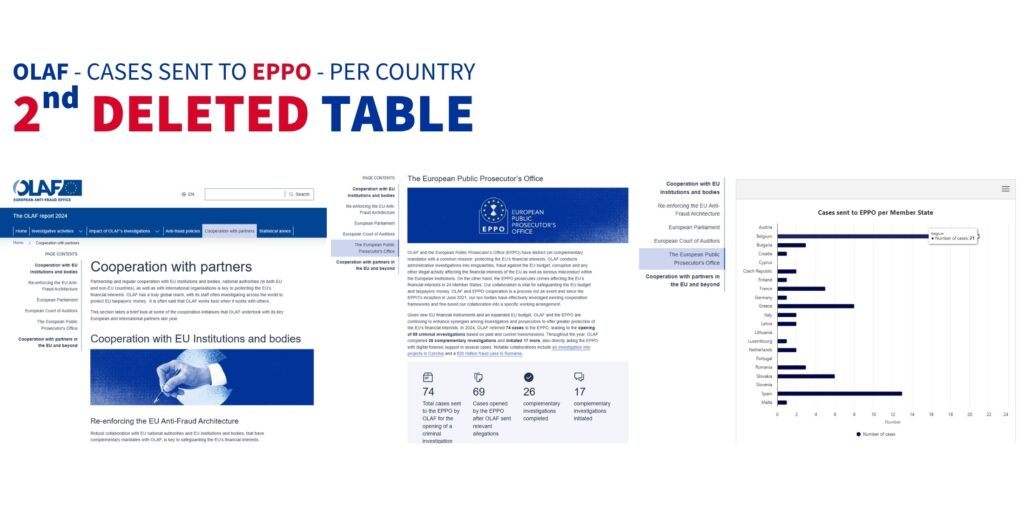
Four contradictions between OLAF’s published mandate under Regulation 883/2013 and Article 325 TFEU, and the verified findings. OLAF closed four investigations in Belgium between 2014 and 2023 against €31.1 billion in total EU funding received. Fewer than Congo (7). Fewer than Uganda (6). On the OLAF Fraud Index, concluded investigations per €1 billion received, Belgium scores 0.13. Romania scores 9.8. A ratio of 1 to 75, documented in OLAF’s own reports, never publicly explained. OLAF’s Press Office stated in writing that “OLAF’s investigative decisions are not based on geographical distribution”. If not geography, then either fraud incidence or detection capacity. The letter asks which. The letter also asks why OLAF removed the member-state complaint intake table from its annual reports in 2019, with no stated legal basis under Regulation 883/2013. FOIA EASE 2025/6477, requesting the decision trail, has been unanswered for more than five months.
To EPPO, the European Public Prosecutor’s Office — EUMM-EPPO-2026-005, 17 April
Four contradictions between EPPO’s stated mandatory competence principle, Article 24(8) of Regulation 2017/1939, and College Decision 063/2023. EPPO processed 83 CMS-registered Belgium reports in 2024, a 177% increase from 30 in 2023, a surge that has never been publicly explained. FOIA PA/2025/10/06/143 confirmed in writing that EPPO holds no documents recording decision grounds for any of the 82 non-investigation disposals for Belgium across 2023 and 2024, in any form. EPPO’s own College Decision 063/2023 Article 7(2) requires a three-year log for every disposal, including action taken and deciding Prosecutor. The letter asks whether EPPO maintains it is in compliance with its own College Decision. It also acknowledges, explicitly, that EPPO’s Legal Service handling of the underlying FOIA demonstrated institutional precision markedly more substantive than comparable responses from other EU oversight actors. That acknowledgement stands separately.
Why institutions must answer
Article 11 of the EU Charter of Fundamental Rights and Article 10 of the European Convention on Human Rights protect the right of citizens and journalists to ask these questions. The Belgian Labour Court applied both in my favour in March 2026, rejecting a motion that would have imposed a €5,000-per-post, per-day penalty to stop all publication.
The institutions named in these letters are funded by the citizens they are asked to account to. Every salary, every office, every audit mission, every communications department, is paid from public money. A seven-working-day response to a documented, sourced, attributed journalistic inquiry built entirely from those institutions’ own records is the minimum standard of public accountability in a Union governed by the rule of law.
Transparency, in such a Union, is not hostility to the institutions, it is a condition of their legitimacy, their credibility, and democratic consent. Every letter I sent carries that line at the foot of every page.
What happens next
The seven-working-day response window began on 15 April for the Commission and the Court of Auditors, on 16 April for the Committee on Budgetary Control, and on 17 April for OLAF and EPPO. By the close of business on 28 April, the Commission and the Court are expected to respond. By 29 April, CONT. By 30 April, OLAF and EPPO.
Every response received will be published in full, attributed by name and institution, alongside the Belgium NGO Funding Intelligence Pack and the original letter that prompted it. Every partial response will be published with a clear note on what was omitted. Every silence will be published as a silence.
Belgium is Volume I. The methodology replicates across all 27 EU member states. €54.45 billion in EU grants to non-profits across the Union has never been mapped at entity level.
The citizens who funded €7.89 billion in Belgian NGO grants are owed the record. The citizens who funded the other €46.56 billion are owed the same.
The 10 Blind Spots of EU Funding Oversight — Belgium Pilot 2026, free 14-page summary: https://insights.brussels-leaks.eu/subscribe
The Belgium NGO Funding Intelligence Pack — Volume I, 758 entities, 29 columns, 14 analytical charts, 31-entity statistical watchlist: brussels-leaks.eu/intelligence