European Commission · European Court of Auditors · European Parliament · European Anti-Fraud Office (OLAF) · European Public Prosecutor’s Office (EPPO)
Can the institutions responsible for EU money prove they can follow EU money: from grant, to legal identity, to public accounts, to workforce, to final recipient — end to end?
Every reply links to the original answer – PDF. We summarise; you read the source. Verbatim, with dates, without interpretation.
Two of the five replied on the substance — the Court of Auditors and the Public Prosecutor. Both confirmed the record. OLAF redirected the questions to a public form without answering them. The Commission and the Parliament — the two bodies with the power to act — did not reply at all.
EPPO confirmed it is not an administrative or audit body, does not work from risk analysis, and cannot audit how grants are awarded or detect structural gaps in the system.
It acts only on individual reported cases, under mandatory competence.
Read plainly, that places the structural oversight squarely back with OLAF and the Commission – the two bodies asked the same questions, and the two that chose not to answer.
One document tells the story.
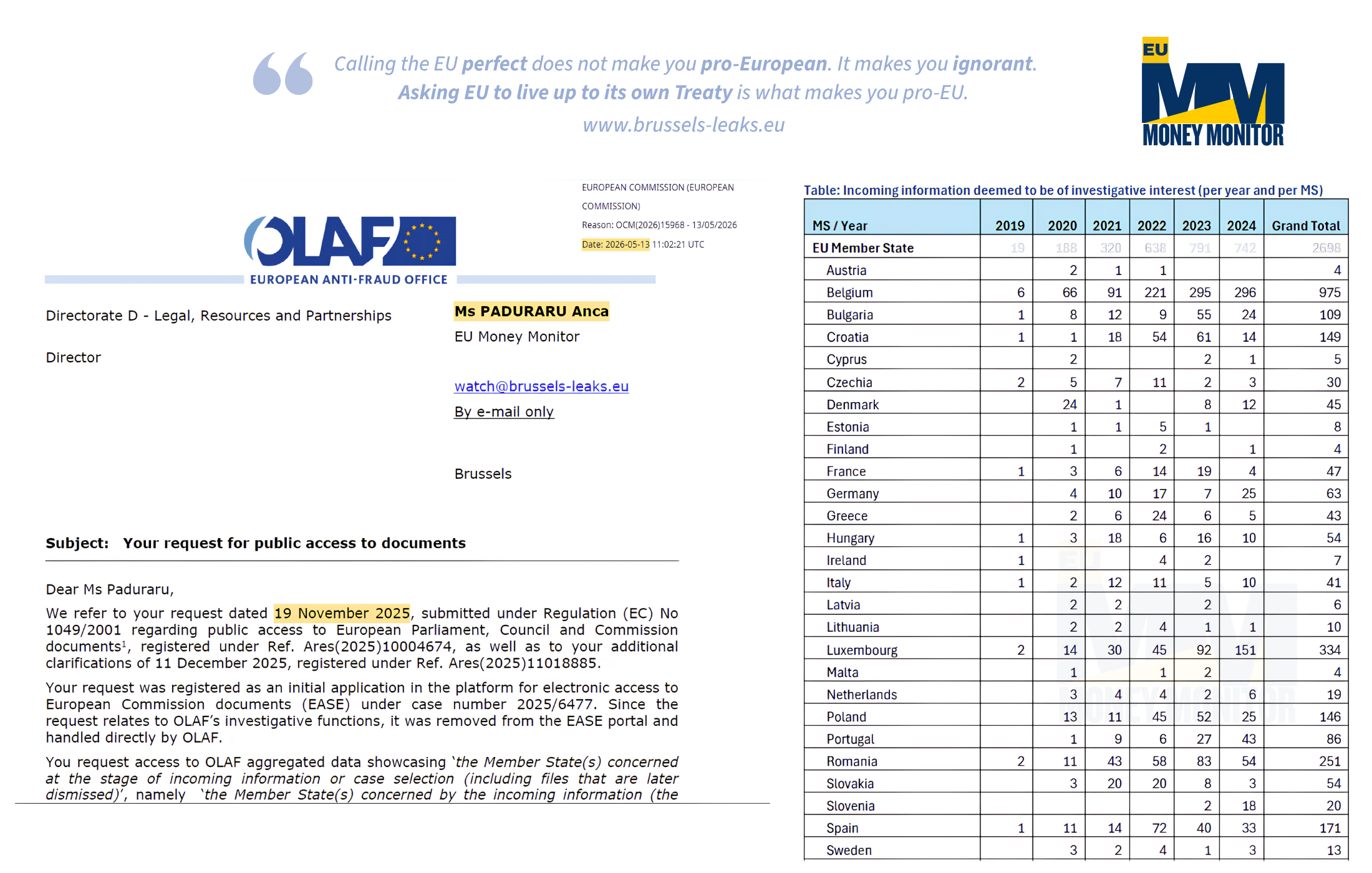
13 MAY 2026: OLAF Access-to-documents request EASE 2025/6477 · sent 5 October 2025 · reply 13 May 2026 · partially answered
Same access-to-documents request. Same institution. Six months. Different answer:
Under Director-General Ville Itäla, November 2025: “OLAF does not hold any documents that would correspond to the description given in your application.”
Under Director-General Petr Klement, May 2026: the same data 2019-2024, “as extracted from OLAF’s Case Management System (OCM).”
The Court confirmed the analysis aligns with its 2025 report on weaknesses in the Commission’s transparency over NGO funding, and said the Belgium mechanism could feed future audits.
It set two caveats on the record: it did not verify the legality of the spending, and there may be valid explanations. It was explicit that acting on the findings falls to the Commission, under Parliament’s oversight.
European Commission
NO ANSWER
Reference:EUMM-EC-2026-002 Sent: 15 April 2026 NO reply Status: Unanswered
Addressed by name to the President, the Budget Commissioner and the Director-General of DG Budget, with twelve named officials in the chain.
Receipt not denied, no extension requested, no finding contested.
Its own 15-working-day standard closed on 6 May 2026. The Commission publishes the funding data and runs the systems behind it – it is the first body that must say what those systems can verify, and what they cannot.
European Parliament · CONT
NO ANSWER
Reference:EUMM-EP-2026-003 Sent: 16 April 2026 NO reply Status: Unanswered
The prior CONT Chair’s public statement:
“There is still no complete overview of EU funding to NGOs.”
— CONT Chair, public statement, April 2025
In April 2025 the committee’s chair said there was still no complete overview of EU funding to NGOs. We sent one — for the Union’s second-largest recipient — with six numbered questions, to twenty named MEPs and offices, deadline 1 June 2026. Neither notification has been answered.
“Please note that as this does not appear to be a media-related request, rather a reporting of findings / journalistic notification, we have forwarded your message to relevant colleagues. As a rule, OLAF Press Team does not assess incoming information. If you would wish to report fraud or further findings which falls into the scope of OLAF, please use the following link.”
— OLAF Press Office, 28 April 2026
OLAF’s press office did not address a single one of the documented findings, gave no file reference, and named no responsible service or official. It redirected the notification to OLAF’s public fraud-reporting form. EU Money Monitor renewed the request on 29 April 2026, stating it was a formal journalistic notification, not a citizen fraud report. OLAF did not dispute the findings. It did not answer them.
The chain on the record. The findings on the next page.
The full investigation organised by the five links of the EU funding accountability chain. Or the dataset itself, in one downloadable Intelligence Pack.